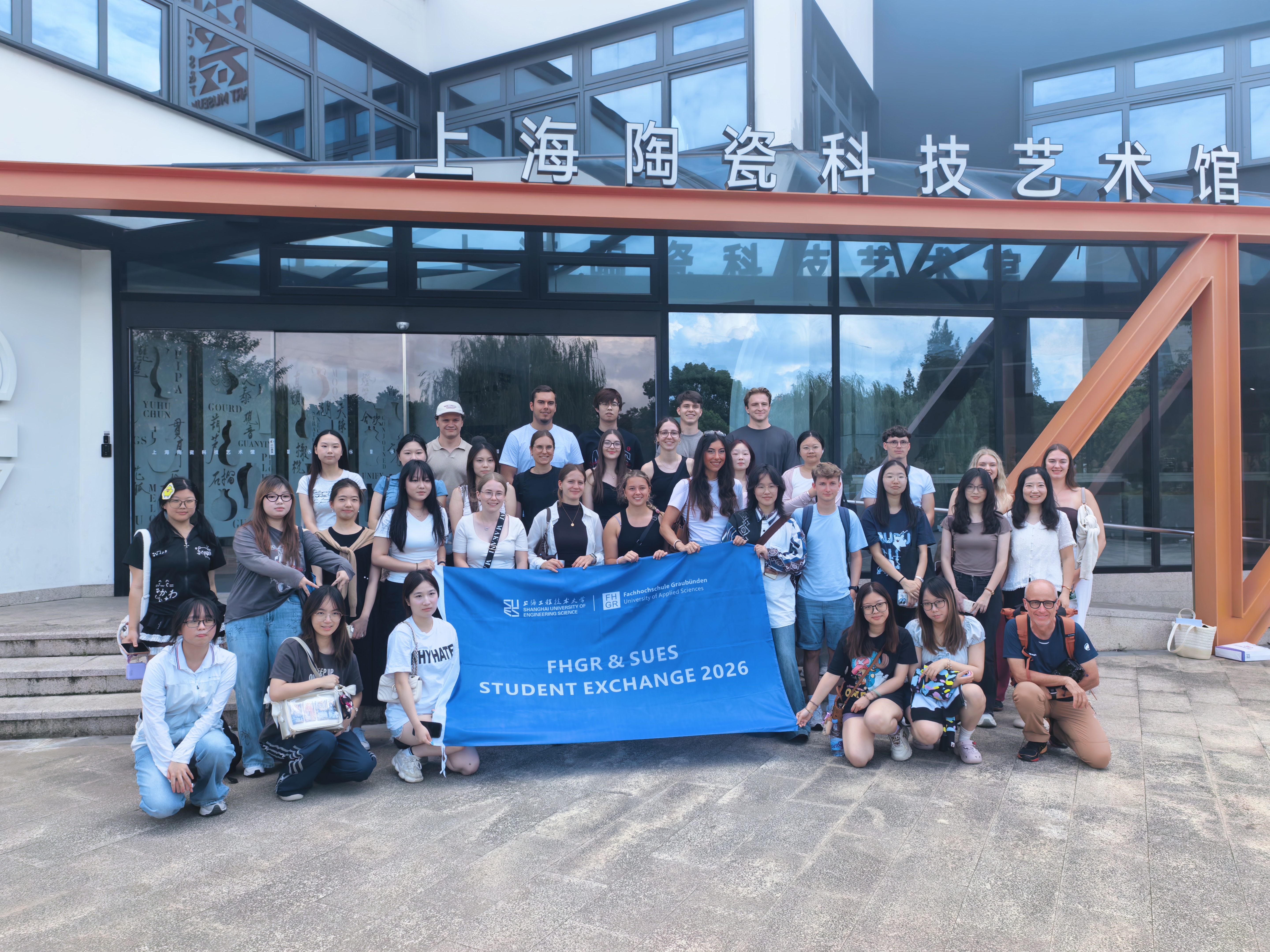
To promote fine traditional Chinese culture and build an international platform for cross-cultural exchange, on September 3, the International Business (Tourism and Business Management) program, jointly offered by SUES and the Graubünden University of Applied Sciences, Switzerland, organized a student exchange and study team to visit Shanghai Ceramic Science and Technology Art Museum, embarking on a cultural study tour that blends Eastern and Western cultures and integrates knowledge with practice.
This study tour is a signature exchange project under the distinctive educational system of the Sino-Switzerland cooperative International Business (Tourism and Business Management) program. Guided by the goal of cultivating internationalized talent, the project introduces Switzerland’s advanced concepts in business and cultural tourism management while deepening immersion in local Chinese culture. It innovatively adopts a one-on-one pairing model between Chinese and Swiss students and draws on the distinctive cultural tourism resources of the Jiangnan region to facilitate two-way learning and in-depth mutual exchange between young people from China and Switzerland.
On the scene, Chinese and Swiss students immersed themselves in exploring the heritage of ceramics, visiting the museum’s twelve themed exhibition areas in an orderly manner. The venue presents, in an all-round and multi-layered way, the millennium-long development of Chinese ceramics from traditional craftsmanship to integration with modern technology, allowing students from China and abroad to directly understand the Eastern craftsmanship spirit of “earth transformed into vessels, kiln fire conveying charm.” The paired Chinese and Swiss students stayed together throughout, communicating and supporting each other in their study. Chinese students carefully explained the cultural connotations of ceramics, the heritage of Jiangnan intangible cultural heritage, and the Chinese aesthetic system, sharing the humanistic stories behind traditional porcelain-making techniques. This transformed static cultural relics and exhibits into a dynamic vehicle for cross-cultural exchange, achieving multi-dimensional educational outcomes in traditional culture learning, curriculum knowledge linkage, language mutual exchange, and the blending of perspectives and horizons.
This Sino-Switzerland paired study tour used ceramic culture as a bond to promote two-way learning and mutual progress among students from China and abroad, writing a vivid practical footnote for the cultivation of internationalized interdisciplinary talent in the Sino-Switzerland cooperative education program.