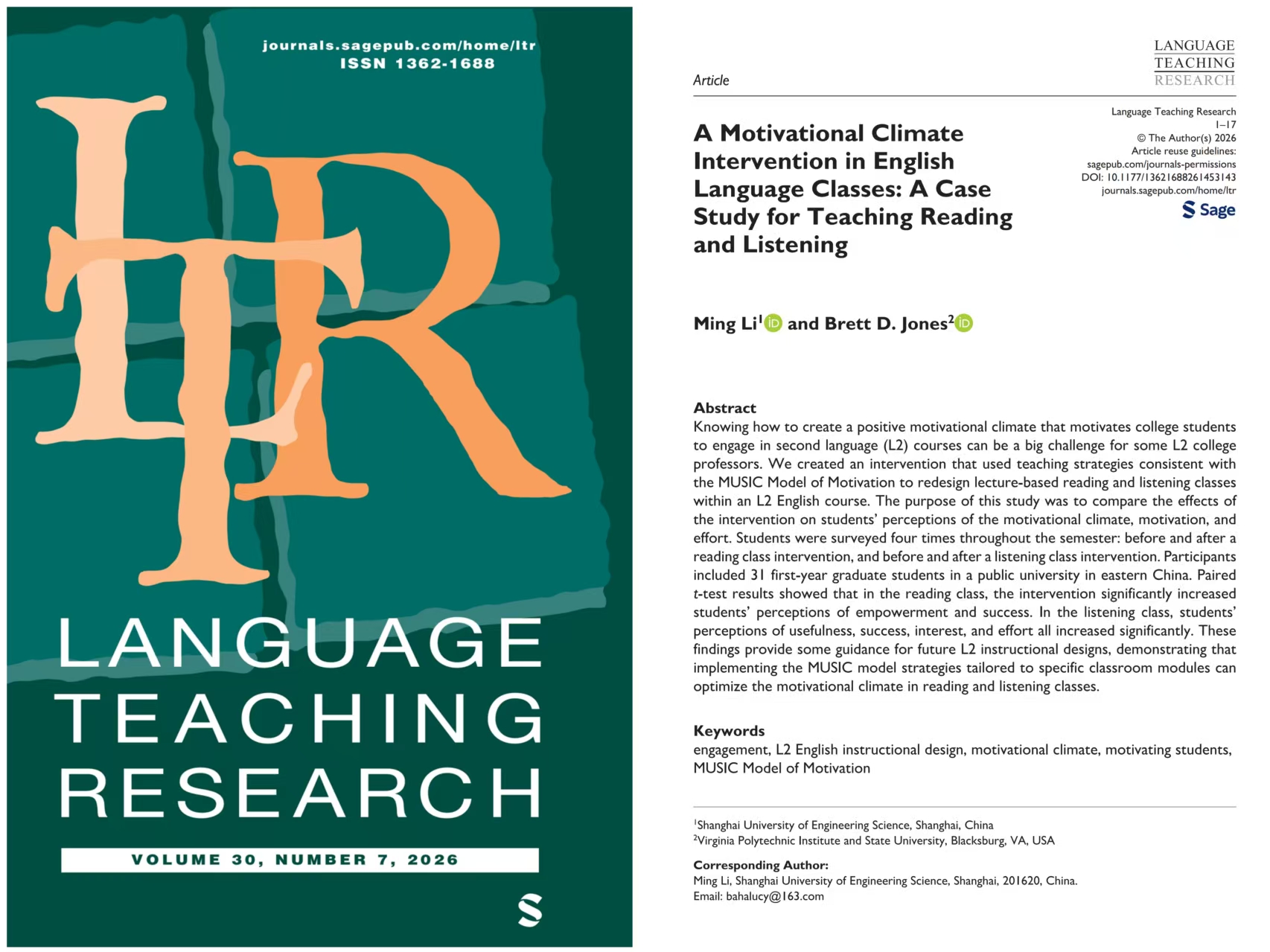
Recently, associate professor Li Ming from the Translation Teaching Team One at the School of Foreign Languages published a research article entitled “A Motivational Climate Intervention in English Language Classes: A Case Study for Teaching Reading and Listening” in the international journal Language Teaching Research. Li Ming serves as the first author and the sole corresponding author of the paper. SUES is the first-affiliated institution of the research. The journal Language Teaching Research is an SSCI Q1 journal and is also ranked Q1 in the Chinese Academy of Sciences (CAS) journal classification, with an impact factor of 4.7 and a five-year impact factor of 6.2, placing it among the leading journals in the field of linguistics. This research was supported by Shanghai Municipal Education Commission’s Overseas Visiting and Training Program for Young and Middle-aged College Professors.
How to create a positive motivational climate that motivates college students to engage in foreign language courses can be a big challenge for some university faculty members. Addressing this issue, the research team designed an intervention based on the MUSIC Model of Motivation and systematically redesigned two graduate-level English courses: an English reading course and an English listening course, both of which had previously adopted primarily lecture-based teaching approaches. Throughout the semester, the instructor conducted four rounds of student questionnaires, including pre- and post-intervention surveys for both the reading and listening courses. The findings showed that in the reading class, the intervention significantly increased students’ perceptions of empowerment and success. In the listening class, students’ perceptions of usefulness, success, interest, and effort all increased significantly.These findings provide some guidance for future foreign language instructional designs, demonstrating that implementing the MUSIC model strategies tailored to specific classroom modules can optimize the motivational climate in reading and listening classes.
This research provides new perspectives and empirical evidence for the design of college foreign language instruction. It has important theoretical and practical implications for enhancing students’ learning motivation, improving classroom engagement, and promoting reforms in foreign language education. The achievement reflects the continuous exploration and academic influence of faculty members at SUES in the field of higher education research, while also providing strong research support for improving teaching quality and advancing innovative classroom practices.