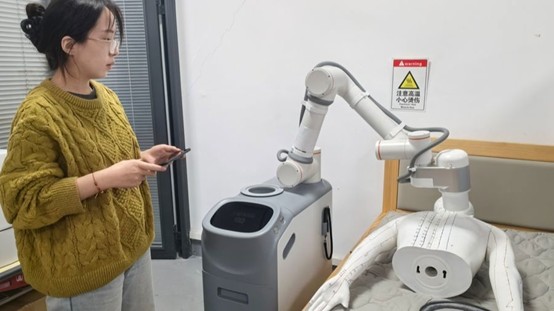
Traditional Chinese Medicine therapy robots have entered service. In the treatment room of the Fifth Rehabilitation Hospital of Songjiang District Shanghai, as the doctor taps and selects specific acupoints and techniques on an iPad, a crisp beep sounds out. The robot's silver-white mechanical arm slowly activates, precisely aligning and hovering over the acupoints on the patient's back, initiating a half-hour of circular moxibustion therapy. As the robotic arm circles back and forth, steadily rotating the burning moxa stick, a gentle warmth gradually permeates the patient's skin.
This is Shanghai's first embodied intelligent robot for moxibustion rehabilitation, currently undergoing clinical trials at multiple medical institutions in Songjiang, Pudong, and other districts, having served over a thousand patients to date. According to feedback from relevant institutions, the incidence of moxibustion burns reported by patients has decreased by 90% since adopting this robot, while a single unit achieves the equivalent work efficiency of four human rehabilitation therapists.
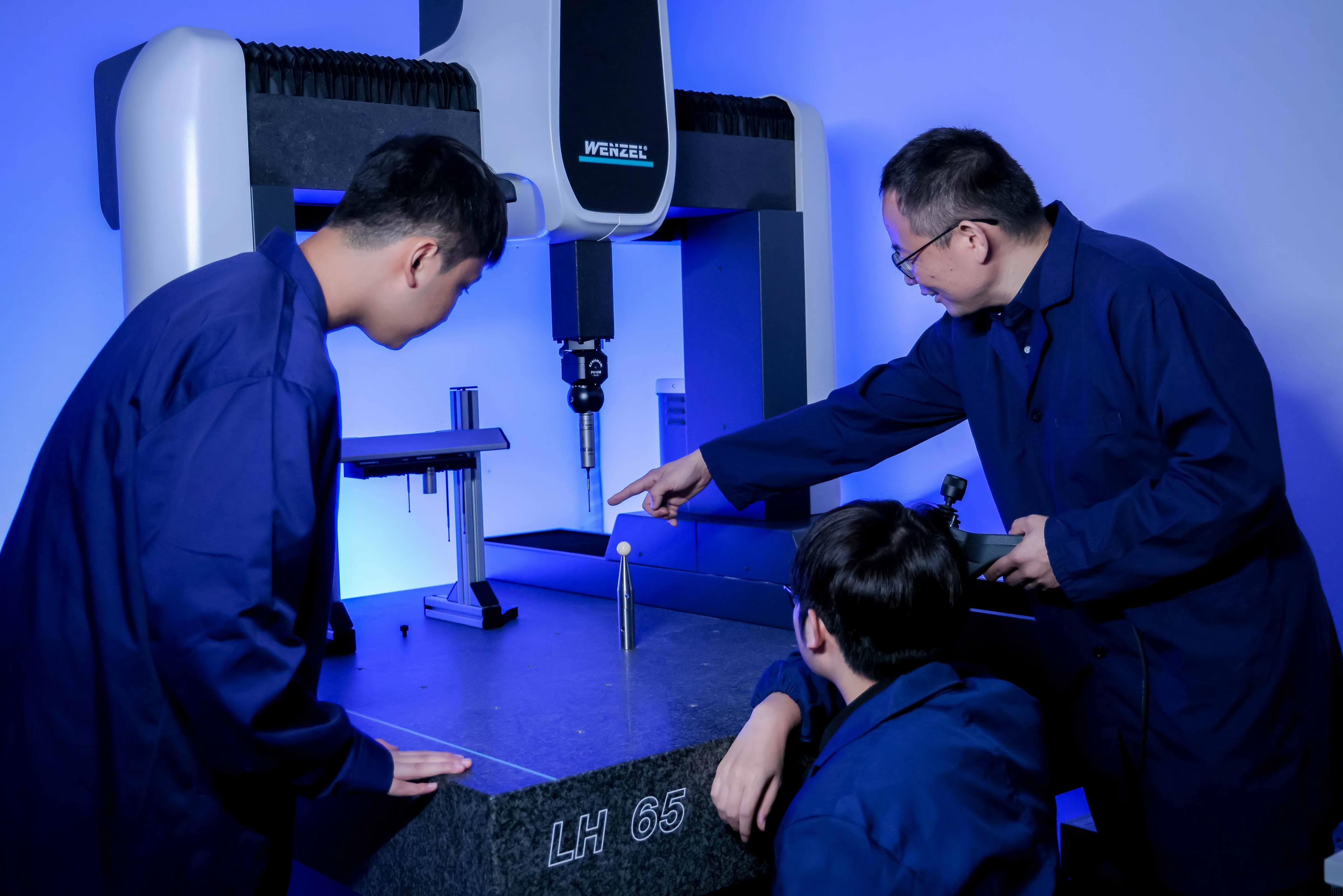
Over the past two years, the moxibustion robot has achieved cumulative sales exceeding 100 million yuan. Behind this success lies the dedication and perseverance of a group of scientists who spent eight years honing their craft. Led by Professor Xiong Genliang, head of the Robotics Engineering program at Shanghai University of Engineering Science, his team collaborated with experts from multiple traditional Chinese medicine universities. By integrating embodied intelligence with digital Qihuang (medical) technology, they faced the pain points of traditional Chinese Medicine and successfully facilitated the transformation of scientific research into practical applications.
From “Sore Arms After 30-Minute Lifting” to One Person “Directing” Eight Robots
Time rewinds to 2017. During an exchange with experts from the University of Traditional Chinese Medicine, Xiong Genliang gained valuable insights. The TCM specialists informed him that while traditional moxibustion was popular among the public, its practical application presented numerous challenges. For instance, though moxa sticks were lightweight, they made rehabilitation procedures physically demanding for practitioners. Practitioners often had to hold their arms raised for half an hour at a time, leading to sore arms and tremors. Moreover, moxibustion relied entirely on experience—since the temperature at the moxa point couldn't be precisely judged by sight alone, accidental burns to patients were common, sometimes resulting in complaints. Others pointed out that the pungent smoke was irritating, and prolonged inhalation could adversely affect health...
At that time, robotic technology was predominantly applied in Western medicine, with few instances of its integration into Traditional Chinese Medicine. Consequently, he considered introducing robotic technology into traditional Chinese physical therapy.
While the vision was promising, once development began, he faced one challenge after another. After years of exploration, his team achieved multiple core breakthroughs. Today, the intelligent moxibustion robot integrates key functions such as 3D acupoint localization, non-contact infrared temperature control, adaptive distance adjustment, and smart smoke and ash removal. Specifically, the robotic arm's outer casing maintains temperatures below 60°C, eliminating burn risks at the source. Built-in temperature and distance sensors detect subtle body movements in real time; should a patient roll significantly, the arm immediately retracts to a safe position and triggers an alarm. Moreover, this robot autonomously removes ash, substantially reducing moxa smoke dispersion and solving the longstanding issue of unpleasant odors associated with traditional moxibustion.
“It can operate continuously for 24 hours without fatigue, blinking, or smoke interference,” explained Xiong Genliang. Throughout the entire process, the only manual intervention required is replacing the moxa sticks and filter cotton. Thus, therapists need only issue commands to the robots via an iPad to simultaneously “direct” eight robots, freeing them from the traditional one-to-one staffing constraints and enabling efficient utilization of medical resources.
Robots Relieving Doctors’ Burdens, Delivering Accessible Health Solutions for All
“Scientific achievements shall not remain confined to laboratories; they must genuinely serve human health”, said Xiong Genliang, who actively promotes technology transfer, with related products successfully obtaining Class II medical device certification. In 2019, he co-founded Shanghai Junkong Robotics Co., Ltd. with a junior fellow apprentice. By 2024, sales of the intelligent moxibustion robot had reached 50 million yuan, setting a new record in 2025 with cumulative sales exceeding 100 million yuan.
The intelligent moxibustion robot has not only become a bestseller in the wellness and beauty industry but has also entered community hospitals, rehabilitation centers for veterans, and other clinical settings. To date, Xiong Genliang's team has accumulated nearly a thousand clinical data entries. Encouragingly, since the robot was put into service, the effectiveness rate for managing patients' chronic conditions has reached 85%, while treatment time has been reduced by 50%.
Technological evolution never ceases. “In the future, simply tell the robot, ‘Xiao Ai, Xiao Ai, help me moxibustion the Zusanli acupoint,’ and it will automatically perform the procedure,” Xiong Genliang told reporters. The team will also incorporate the expertise of Traditional Chinese Medicine specialists to refine the efficacy evaluation system. By comparing data before and after treatment courses, patients will be able to visually track their physical changes.
The moxibustion robot is just a beginning. In Xiong Genliang's lab, more new devices—including intelligent acupuncture robots, bionic massage hands, and smart shockwave therapy systems—are being developed at a rapid pace. “We aim to free human practitioners from repetitive, physically demanding tasks so they can focus on delivering more compassionate and meaningful care,” said Xiong Genliang. He also revealed that the team plans to collaborate with experts from relevant institutions to integrate AR/VR, digital Qihuang (Medical) technology, large language models, and voice interaction into next-generation products. This will propel traditional Chinese physical therapy further along the path of intelligent advancement, offering more accessible solutions for public health.